
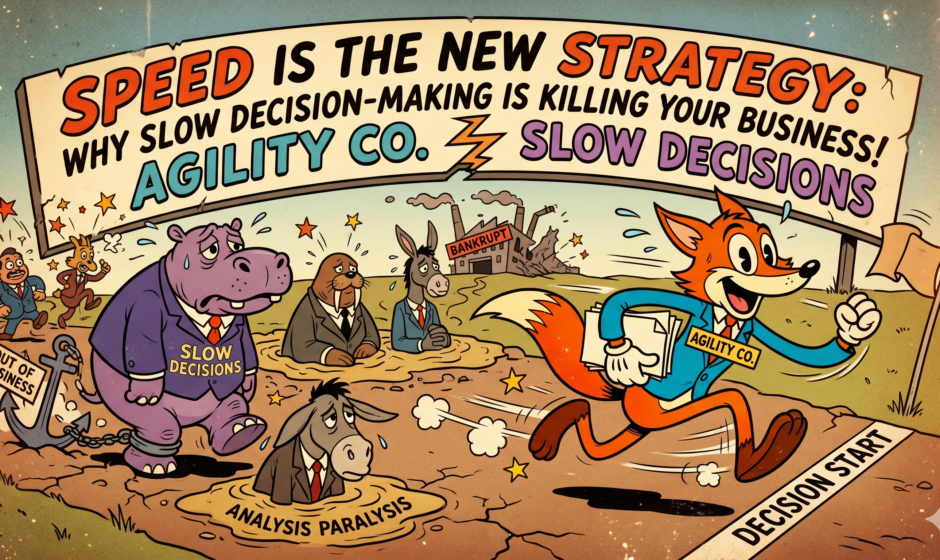

In exponential markets, the competitive landscape shifts faster than most organizations can hold a meeting. While your team is scheduling a follow-up to discuss the follow-up, your more agile competitor has already shipped, learned, and iterated. Speed isn’t just an operational preference anymore. It’s a primary strategic advantage.
The uncomfortable truth is that most businesses don’t lose to smarter competitors. They lose to faster ones.
Decision velocity — the rate at which an organization can move from information to action — is now one of the most critical factors separating market leaders from market laggards. When technology cycles compress from years to months, and customer expectations shift overnight, slow deliberation isn’t caution. It’s a liability.
So what’s actually slowing organizations down? Usually it’s one of three culprits: unclear ownership, consensus addiction, or information hoarding. Teams wait for everyone to agree before moving. Leaders hold decisions hostage to perfect data. Departments protect information rather than sharing it. The result is an organization that thinks carefully and acts too late.
Here’s a framework to fix it.
First, implement a decision tiering system. Not every decision deserves the same process. Categorize decisions into three tiers: reversible and low-stakes, reversible and high-stakes, and irreversible. Reversible low-stakes decisions should be delegated immediately and made fast. Reversible high-stakes decisions need a defined owner, a deadline, and a bias toward action. Only irreversible decisions warrant deep deliberation and full alignment. Most organizations treat everything like it’s irreversible. That’s where velocity dies.
Second, replace consensus with consultation. Consensus means everyone agrees before moving. Consultation means the decision-maker gathers relevant input and then decides. Shifting from consensus culture to consultation culture alone can cut decision timelines by half. People still feel heard. But the organization actually moves.
Third, set decision deadlines by default. Every open decision should have an expiration date. If a decision isn’t made by the deadline, it defaults to a predefined fallback or escalates automatically. This eliminates the organizational purgatory where decisions simply float, unresolved, draining energy and momentum.
Fourth, build a learning loop into every fast decision. Speed without feedback is just recklessness. After each major decision, run a quick retrospective. What did we assume? What happened? What do we adjust? This loop is what separates agile organizations from chaotic ones. You’re not sacrificing quality — you’re distributing it across time rather than front-loading it into endless analysis.
The goal isn’t to be reckless. It’s to recognize that in exponential environments, waiting for certainty is itself a high-risk strategy. The organizations winning right now aren’t the ones with the best plans. They’re the ones who can sense, decide, act, and learn faster than anyone else.
Decision velocity isn’t about moving fast for the sake of speed. It’s about compressing the time between insight and impact. That compression is where competitive advantage lives today.
If your organization is still running on slow-burn decision cycles designed for a more predictable era, the market isn’t going to wait for you to catch up.
Ready to build a faster, sharper, more decisive organization? Explore the frameworks and tools at Exponential Agility and start closing the gap between where you are and where the market is going.
Share this content: