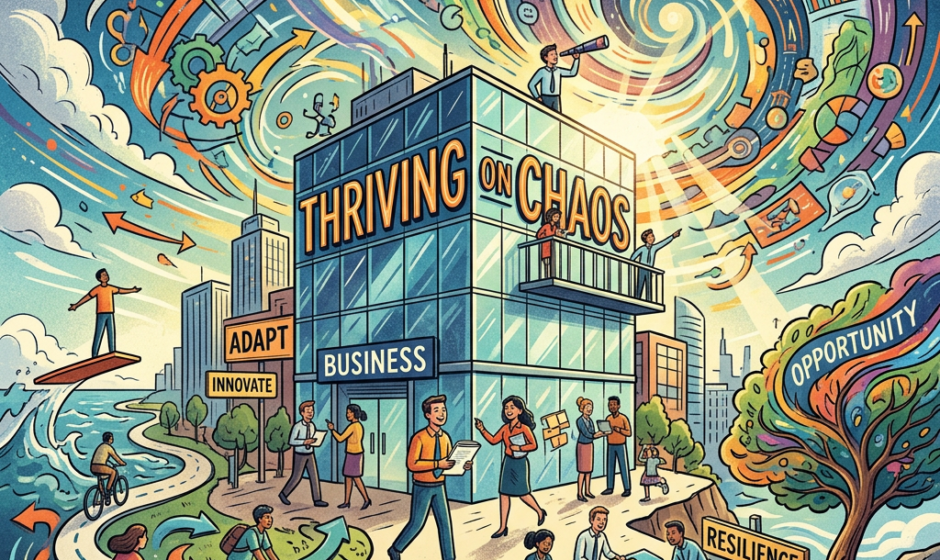

Most businesses are built to survive disruption. The best ones are built to profit from it. There’s a meaningful difference between those two ambitions, and it starts with how you think about uncertainty.
Nassim Taleb coined the term “antifragile” to describe systems that don’t just resist stress but actually get stronger because of it. Muscles work this way. Immune systems work this way. Your business can work this way too, but only if you design it intentionally.
The first step is to stop treating volatility as the enemy. Market shifts, competitive pressure, economic turbulence – these aren’t problems to eliminate. They’re signals. Organizations that fear chaos spend their energy building walls. Antifragile organizations spend their energy building sensors, so they can read what’s happening faster than anyone else and move accordingly.
Step one is to audit your brittleness. Look honestly at where your business breaks under pressure. Single supplier dependencies, revenue concentrated in one client, teams that can’t function without a specific leader – these are fragility points. List them. Rank them. Then systematically reduce your exposure to each one.
Step two is to create optionality. Antifragile businesses don’t bet everything on one strategy. They run small, low-cost experiments across multiple directions simultaneously. When conditions shift, they already have options ready to scale. Think of it as holding a portfolio of possibilities rather than a single plan.
Step three is to build feedback loops that are faster than the market. If your competitors discover a trend in six months and you discover it in six weeks, you’ve turned uncertainty into an advantage. This means investing in real-time data, customer listening systems, and teams empowered to act on what they learn without waiting for approval chains.
Step four is to decentralize decision-making. Rigid hierarchies are fragile by design. When information has to travel up ten levels before action happens, you lose. Antifragile organizations push authority to the edges, to the people closest to the customer, the market, and the problem. They set clear principles and then trust their teams to apply judgment.
Step five is to reframe failure as information. A culture that punishes mistakes creates people who hide problems until they become catastrophes. A culture that treats failure as data creates people who surface issues early, learn quickly, and iterate before small problems become large ones.
None of this means embracing recklessness. Antifragility isn’t chaos for chaos’s sake. It’s deliberate design that allows your organization to extract value from disorder while limiting downside exposure. You protect your core. You expose your edges to stress. You learn. You adapt. You grow stronger.
The businesses that will lead their industries over the next decade aren’t the ones with the most detailed five-year plans. They’re the ones building the capability to respond brilliantly to futures nobody predicted.
Chaos isn’t coming. It’s already here. The only question is whether your business is designed to fear it or feed on it.
If you’re ready to redesign your organization for antifragility, Exponential Agility can help you build the frameworks, culture, and decision-making systems that turn disruption into your competitive edge. Get in touch today.
Share this content: