
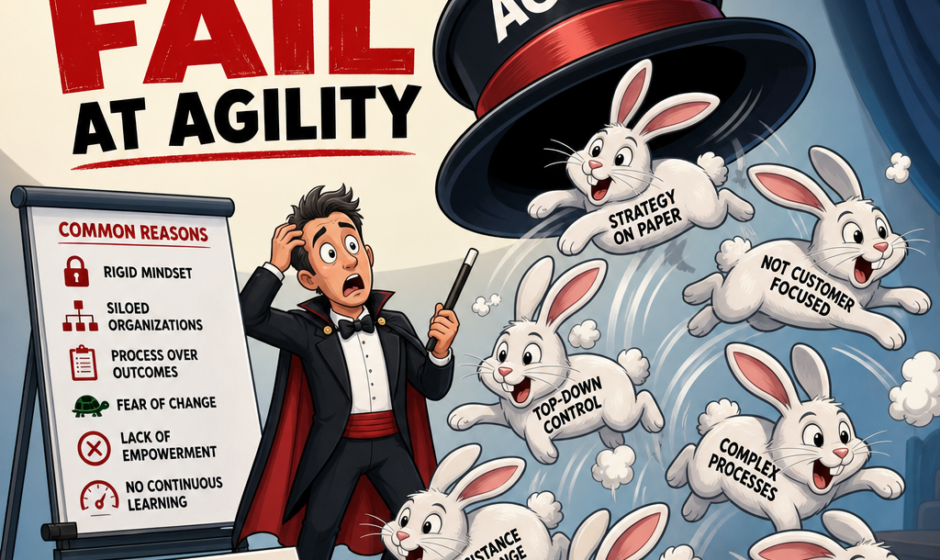

Every boardroom buzzword eventually meets reality. For most organizations, business agility is no different. Leaders invest in agile frameworks, hire transformation consultants, and rebrand their planning cycles — yet the results remain frustratingly incremental. According to McKinsey, fewer than 10% of large-scale agile transformations fully deliver on their intended outcomes. That is not a statistic to gloss over. It is a crisis hiding in plain sight.
So why do so many organizations fail — not at knowing agility exists, but at actually becoming agile? The answer is almost never about tools, processes, or methodology. It is about mindset. And until leaders confront three fundamental misconceptions at the core of how they think about agility, no framework will save them.
The Agility Illusion: What Most Organizations Get Wrong
Before we talk about solutions, let us be honest about the problem. Most businesses approach agility as a project — something with a start date, a budget, and a completion milestone. They implement Scrum, launch an Agile Center of Excellence, or run two-week sprints in their IT department and call it a transformation.
But agility is not a project. It is a capability — one that must be cultivated at every level of the organization, from the C-suite to the front line.
Here are the most common misconceptions leaders hold:
- Agility equals speed. Moving fast without direction is chaos, not agility.
- Agility is an IT or tech initiative. Real agility touches strategy, culture, finance, and operations equally.
- Adopting a framework means being agile. SAFe, Scrum, and OKRs are enablers — not outcomes.
- Agility means no structure. The most agile organizations are highly disciplined, not freestyle.
These misconceptions create what we call the Agility Illusion — the appearance of transformation without the substance. And it is costing organizations billions. A 2023 PMI report found that organizations waste an average of $97 million for every $1 billion invested in projects and programs due to poor change execution. Much of that waste is rooted in misaligned thinking about what agility actually demands.
The 3 Mindset Shifts That Separate Thriving Organizations from Stagnant Ones
The good news? The gap between failing at agility and mastering it is bridgeable — but only when leaders are willing to challenge deeply held assumptions. Here are the three transformative shifts that change everything.
Shift 1: From Efficiency Obsession to Adaptability as Strategy
For decades, the dominant business logic was optimization. Lean out the process. Eliminate waste. Maximize throughput. This mindset served organizations well in stable, predictable environments. But we no longer live in that world.
The organizations that outperform their peers today are not the most efficient — they are the most adaptable. Amazon did not dominate retail by running the tightest warehouse. It dominated by continuously sensing shifts in customer behavior and reconfiguring its business model faster than competitors could respond.
The shift here is from treating adaptability as a reactive necessity to treating it as a proactive competitive strategy. This means:
- Deliberately building slack into systems so teams can pivot without breaking
- Rewarding experimentation and learning, not just execution
- Designing strategy as a portfolio of options, not a fixed roadmap
- Investing in sensing mechanisms — market intelligence, customer feedback loops, and internal data systems
Netflix exemplifies this shift. When DVD rentals were still profitable, they were already building streaming infrastructure. Efficiency thinking would have said: double down on what is working. Adaptability thinking said: prepare for the world that is coming. The result? They did not just survive disruption — they caused it.
Shift 2: From Hierarchical Control to Distributed Decision-Making
One of the most insidious agility killers is the belief that control and coordination require centralization. Leaders hold tightly to decision authority, approvals flow upward through layers of management, and by the time a response is authorized, the opportunity — or the crisis — has already passed.
True agility demands a fundamentally different operating model: one where decision-making authority is pushed as close to the work as possible.
This does not mean anarchy. It means creating clear boundaries of autonomy, equipping teams with the context and capabilities they need, and trusting them to act. Spotify’s famous squad model — despite its real-world imperfections — pointed toward this truth: when teams have clear missions and real authority, they move faster and innovate more consistently than any top-down directive could enable.
The data backs this up. A Deloitte study found that organizations with high decision-making agility — meaning decisions are made at the right level with the right speed — are 6.2 times more likely to be high-performing than those that centralize decision authority.
Making this shift requires leaders to do something genuinely difficult: let go. It requires redesigning governance models, redefining leadership roles from directors to enablers, and building the psychological safety that allows teams to make — and learn from — decisions without fear of blame.
Shift 3: From Annual Planning Cycles to Continuous Strategic Adaptation
Perhaps no organizational habit is more deeply entrenched — or more incompatible with real agility — than the annual planning cycle. Every autumn, leadership teams retreat, build elaborate spreadsheets, and produce a plan that is often outdated before the ink dries.
In a world where AI disrupts entire industries overnight, geopolitical shifts reshape supply chains in weeks, and customer preferences evolve in real time, the idea that a 12-month plan can serve as a reliable guide is not just outdated — it is dangerous.
The shift here is toward continuous strategic adaptation: a cadence of regular strategic reviews, rolling forecasts, and rapid reallocation of resources based on what is actually happening in the environment.
This does not mean abandoning long-term vision. It means separating the direction (which can be stable) from the path (which must remain flexible). Organizations like Haier, the Chinese appliance giant that restructured itself into thousands of micro-enterprises, have shown that it is possible to operate at massive scale while maintaining the strategic responsiveness of a startup.
Practical elements of this shift include:
- Quarterly or even monthly strategy reviews tied to real market signals
- Rolling 90-day priorities that align with a 3-year north star
- Dynamic resource allocation — moving budget and talent to emerging opportunities rather than defending legacy allocations
- Leadership cadences designed for learning and adaptation, not just performance reporting
Why These Shifts Are Urgent — Not Optional
The organizations that fail to make these shifts are not standing still. They are falling behind — and the acceleration of change means the gap widens every quarter. The World Economic Forum estimates that 50% of today’s S&P 500 companies will be replaced within the next 10 years. The primary driver of that displacement will not be bad products or poor execution alone — it will be the inability to adapt fast enough.
Meanwhile, organizations that have internalized these three shifts are not just surviving — they are compounding their advantages. They attract better talent, respond to market changes before competitors even notice them, and build organizational cultures where innovation is the default, not the exception.
Where Do You Start?
The honest answer is: with an honest assessment. Most leaders overestimate their organization’s actual agility. Before investing in another framework or methodology, ask these questions:
- How long does it take your organization to make a significant strategic decision?
- When was the last time your team abandoned a plan because the environment changed — and celebrated that pivot?
- Can your frontline teams act on customer insights without waiting for leadership approval?
- Does your annual planning process energize or constrain your organization?
Your answers will reveal exactly where the real work needs to happen.
The Bottom Line
Agility is not a destination. It is a discipline — one that requires ongoing investment in mindset, culture, and capability. The 90% of organizations that fail at it do not lack the tools. They lack the willingness to challenge the assumptions that built their success in the first place. The three shifts outlined here — from efficiency obsession to adaptability as strategy, from hierarchical control to distributed decision-making, and from annual planning to continuous strategic adaptation — are not easy. But they are the only path forward in a world that rewards the responsive and punishes the rigid.
The organizations that thrive in the next decade will not be the ones that planned best. They will be the ones that adapted fastest.
Ready to Build Real Agility in Your Organization?
If you are serious about moving from agility theater to genuine organizational transformation, the starting point is clarity — about where you are, what is holding you back, and what the path forward looks like for your specific context.
Download our free Exponential Agility Assessment to benchmark your organization across the three shift dimensions and get a personalized roadmap for your transformation journey. Or schedule a 30-minute strategy call with our team to explore how these principles apply directly to your business.
The window to lead this shift — rather than be forced into it — is open right now. Do not wait until the next disruption makes the choice for you.
Share this content: