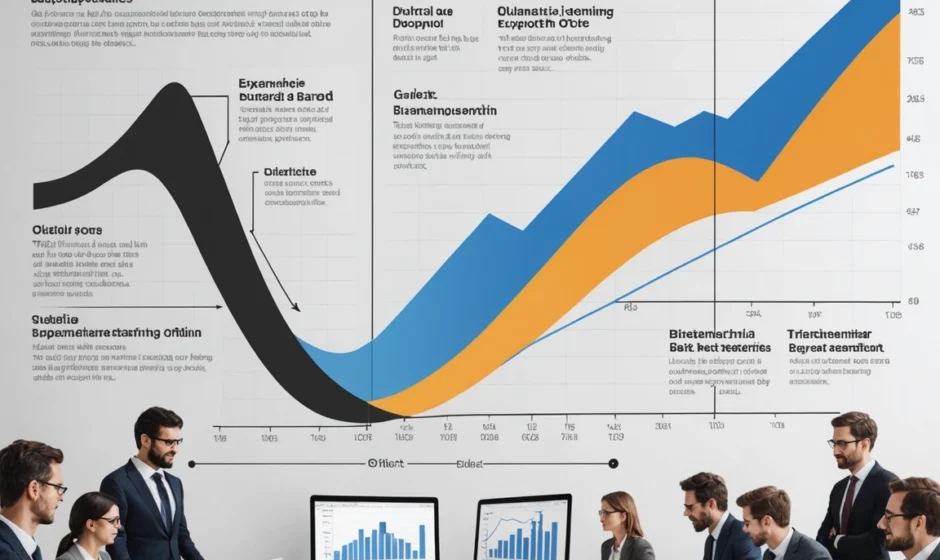

Most businesses are built for a world that no longer exists. They plan in straight lines, budget in straight lines, and think in straight lines. But the forces reshaping industries today don’t move in straight lines. They move exponentially.
Understanding the difference isn’t academic. It’s the gap between thriving and becoming irrelevant.
Linear growth is predictable and comfortable. You add one salesperson, you get roughly one salesperson’s worth of output. You open one new location, revenue increases by a proportional amount. It’s the kind of growth that feels safe because you can see every step ahead of you.
Exponential growth works differently. It starts slow, almost invisibly slow, then it explodes. Think about how Netflix spent years looking like a niche DVD service before it restructured the entire entertainment industry. Or how Airbnb went from a quirky air mattress rental idea to displacing hotel chains worth billions. The early stages looked underwhelming. The later stages were unstoppable.
That’s the trap most business leaders fall into. They dismiss exponential technologies and models because they don’t look threatening yet. By the time the curve becomes obvious, it’s already too late to respond effectively.
So where does your organization actually sit on the exponential readiness spectrum?
Ask yourself these questions honestly. Is your team still making decisions primarily based on last year’s data, or are you building systems that learn and adapt in real time? Are your competitive advantages tied to physical assets and headcount, or to scalable platforms and data? When a disruptive competitor enters your space, is your first instinct to defend your current model or to ask what they understand that you don’t?
Companies riding the exponential curve share a few common traits. They treat technology adoption as a core competency, not an IT function. They build feedback loops that generate compounding intelligence over time. They’re willing to cannibalize their own business models before someone else does it for them.
Companies getting crushed tend to optimize endlessly for efficiency within a model that’s already becoming obsolete. They confuse activity with progress. They invest in perfecting the past.
The honest truth is that most organizations are somewhere in the middle, which is actually the most dangerous place to be. You’re doing well enough that urgency feels low, but you haven’t built the capabilities needed for what’s coming next.
The exponential curve doesn’t wait for quarterly planning cycles or board approvals. AI is compressing development timelines that used to take decades into months. Platforms are allowing tiny teams to scale globally overnight. Customer expectations are being reset constantly by the most innovative experience they’ve had anywhere, not just in your category.
The question isn’t whether exponential change is coming for your industry. It already has. The question is whether you’re building an organization capable of accelerating with it or one that will be left explaining to stakeholders why the disruption you saw coming somehow still caught you off guard.
Readiness isn’t a technology investment. It’s a strategic mindset that has to be built deliberately, starting now.
Ready to find out exactly where your organization sits on the exponential readiness spectrum? Take our assessment and get a clear picture of your strengths, blind spots, and the specific moves that will matter most for your business.
Share this content: