
In the modern economy, the way you structure your work determines how much of your budget actually turns into profit. Many organizations are finding that while they are “efficient” at finishing projects, they aren’t actually seeing an increase in Return on Investment (ROI).
The shift from Project Management to Value Stream Management is often the missing link.
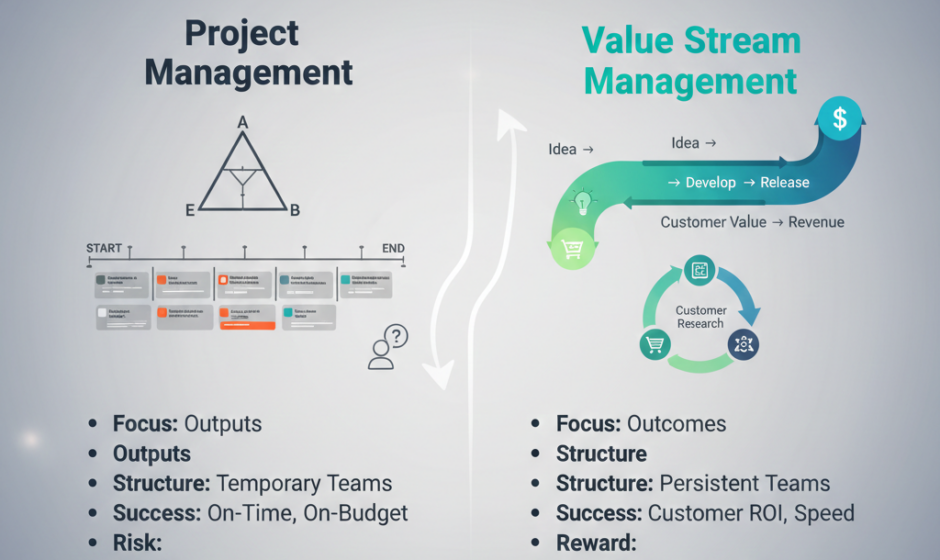
1. Project Management: The “Output” Focus
Traditional project management is built around a start date, an end date, and a specific set of deliverables. Success is measured by the “Iron Triangle”: staying on time, on budget, and within scope.
- Structure: Temporary teams brought together for a specific task and disbanded afterward.
- The Risk: You can finish a project perfectly on time and on budget, but if the market has shifted, that project might deliver zero value to the customer. This leads to “zombie projects” that consume resources without moving the needle on ROI.
2. Value Stream Management: The “Outcome” Focus
A value stream is the end-to-end set of activities required to deliver a product or service to a customer. It doesn’t “end” when a feature is shipped; it continues as long as the product exists.
- Structure: Persistent, cross-functional teams organized around a customer journey or a product line.
- The Reward: Success is measured by business outcomes—like customer retention, revenue growth, or reduced “lead time” (the time from an idea to cash in the bank).
3. Why Value Streams Increase ROI
Shifting to a value stream mindset directly impacts your bottom line by eliminating “The Three Silos of Waste”:
Reduced Handoffs
In projects, work often moves from Marketing to Design to Engineering to QA. Every handoff is a delay. Value streams keep the team together, reducing idle time and accelerating the Flow Velocity.
Continuous Re-prioritization
Static project budgets are often locked in for 12 months. Value streams allow for Lean Budgeting, where funding is allocated to the stream. If a specific feature isn’t performing, the team can pivot immediately to a higher-value task without waiting for the next annual planning cycle.
Data-Driven Decisions (Flow Metrics)
Instead of tracking “percent complete,” value stream management uses metrics that correlate to ROI:
- Flow Efficiency: How much time is spent on actual work vs. waiting?
- Flow Time: How fast can we turn an investment into a customer-facing feature?
The Verdict
If you want to manage costs, manage projects. If you want to manage wealth, manage value streams. By focusing on the continuous flow of value rather than the completion of tasks, organizations can ensure that every dollar spent is optimized for maximum impact.
Share this content: