
Every few years, business culture latches onto a word and squeezes it until the meaning runs dry. Synergy. Disruption. Pivot. Agility has suffered the same fate — diluted into a vague aspiration that sounds good in strategy decks but gets dismissed in boardrooms where real decisions happen.
That’s a costly mistake.
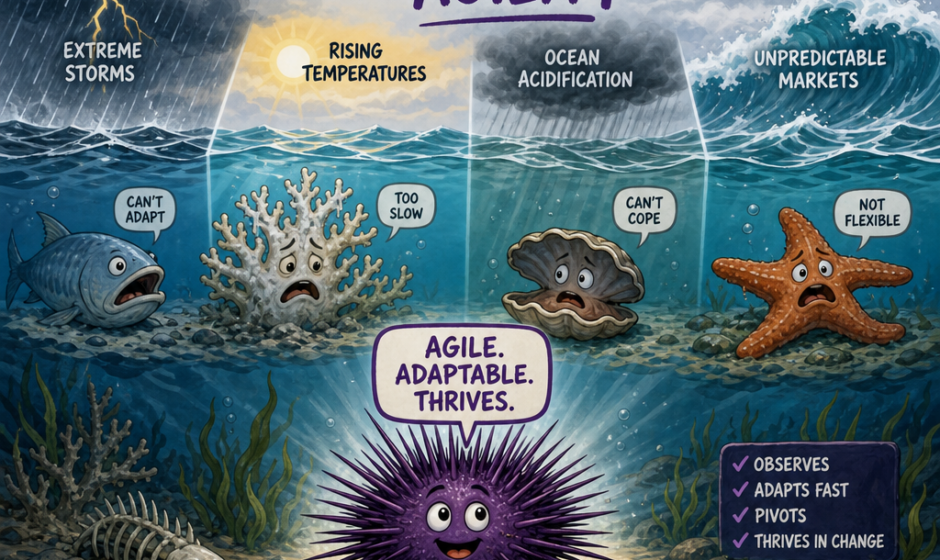
Agility isn’t a management philosophy or a trendy framework borrowed from software developers. It’s a survival capability. It’s the organizational equivalent of a immune system — invisible when things are running smoothly, absolutely critical when they’re not.
Consider what happened during the pandemic. Companies that had built flexible supply chains, empowered decision-making at every level, and cultivated a culture of rapid experimentation adapted within weeks. Their rigid competitors — the ones still running five-year plans through twelve layers of approval — spent those same weeks watching their models collapse in slow motion.
The pattern isn’t new. It repeated during the 2008 financial crisis. It repeated when e-commerce rewrote retail. It’s repeating right now as artificial intelligence reshapes entire industries faster than most leadership teams can schedule a meeting to discuss it.
Rigid organizations don’t fail because their people are untalented or their strategies are unintelligent. They fail because their structure punishes speed. Information moves slowly. Decisions require consensus from people too far removed from the problem. By the time a response is approved, the window has closed.
Agile organizations are built differently from the ground up. They treat uncertainty as a constant rather than an exception. They create systems where learning happens continuously, not annually. They give teams the authority to respond without waiting for permission, and they build feedback loops tight enough to course-correct before small problems become expensive ones.
This isn’t soft culture work. It’s structural. It shows up in financial performance.
Research consistently shows that organizations with high agility scores outperform their industry peers in revenue growth, profitability, and employee retention — especially during periods of volatility. When markets shift, agile companies don’t just survive the shock. They frequently use it as an opportunity to capture market share from competitors who are still frozen in place.
The businesses that will define the next decade aren’t necessarily the ones with the biggest budgets or the most recognizable brands. They’re the ones that can sense change early, decide quickly, and execute without the drag of excessive process and bureaucratic inertia.
The question isn’t whether your industry will face disruption. It will. The question is whether your organization is structured to move faster than the disruption — or slower.
Agility is not a buzzword you adopt for your next all-hands meeting. It’s a capability you build deliberately, layer by layer, until it becomes the operating system your entire business runs on.
The organizations that treat agility as optional are making a bet that the future will be predictable. That bet has never paid off.
Ready to find out how agile your organization actually is — and where the gaps are costing you? Explore our Exponential Agility assessment and start building the capability that turns disruption into your competitive advantage.
Share this content: